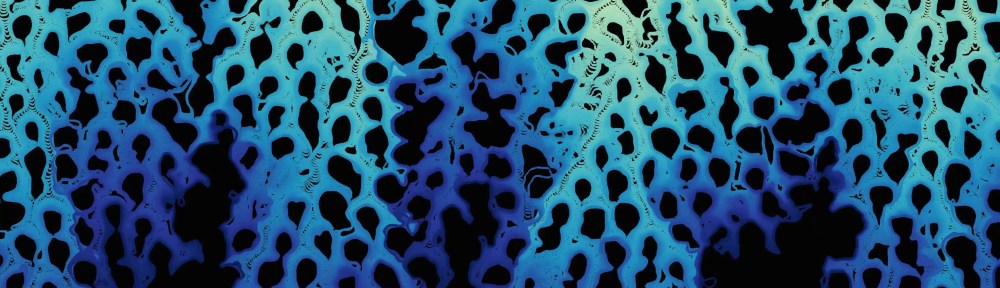
Mixing in porous media is a non-linear process. The flow is coupled to the porous matrix, but the flow structures may be much larger than the characteristic pore size. These finger-like structures form, grow and merge, and control the mixing process. In this multiphase and multiscale system, making accurate predictions is a challenging task. Mixing is controlled by the combined action of convection, diffusion and viscous dissipation. With the aid of experiments and simulations, we studied this complex system and provide simple physical models describing the flow evolution in all the stages of the mixing process.
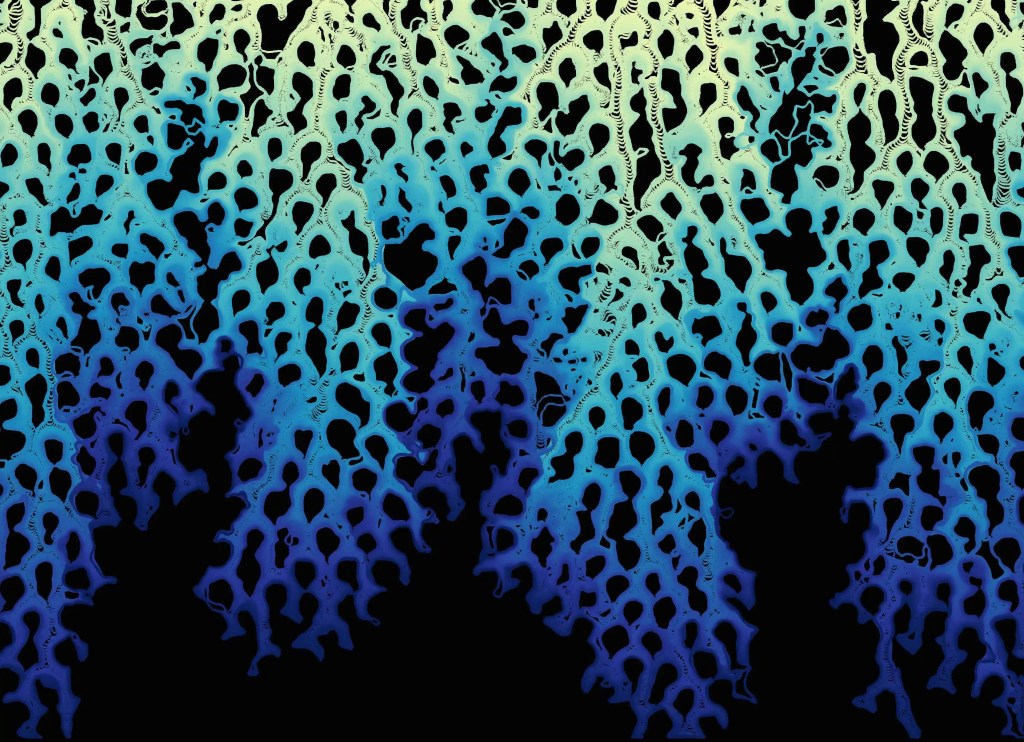
Experiments consists of bead packs and two miscible fluids of different color. In the simulations, we combined multiple grid resolutions and immersed boundaries method to resolve high-Schmidt number flows in the pore-space. Finally, we use these results to gain a quantitative understanding of the flow evolution, and in particular of the mixing.
The paper and the data are freely accessible.
What does the image above represent? It is obtained from experimental measurements of the interface. The evolving interface between the fluids is tracked. The color changes with time, and as a results this figure contains information about the entire flow evolution. The movie below shows how the interface is tracked. Do you want to know more? Contact me!
This work was funded by the European Union’s Horizon Europe research and innovation programme under the Marie Sklodowska-Curie grant agreement MEDIA no. 101062123, the Max Planck Center for Complex Fluid Dynamics, PRACE (project 2021250115) and the Austrian Science Fund (FWF) (J-4612).
 Marco De Paoli