Flow-induced morphology modifications
Porous media with morphology modifications are everywhere around us. For example, think of a snowpack subject to snow melting and water refreezing. Snow represents one of the largest freshwater resources available on Earth, and predicting its dynamics is crucial to have reliable climate models. But… snow is an extremely complex system, consisting of a solid icy matrix filled with air. When the ice crystals at the top of the snowpack melt due to the solar radiation, the resulting meltwater penetrates downwards, eventually refreezing. Water, ice and air interact in a complex manner, exchanging heat and influencing each other dynamics: as a result, predicting the evolution of snowpacks is challenging.
Another example of flow-induced morphology evolution is the dissolution of rocks in underground formations. During the process of geological carbon dioxide sequestration or in presence of Karstic formations, the porous rocks “dissolve” or “grow” due to the local increase of the concentration of minerals, e.g., calcite. This effect produces a variation in the medium morphology, namely new paths may open or existing pores close, and thus influences the flow: also in this case, determining the effect of the flow on the medium morphology, and viceversa, is arduous: dissolution or mineralization occur over hundreds or thousands of years, and experiments and modelling in analogue systems are essential.
ERC Starting Grant
This grant (2025-2030) has been awarded by the European Research Council and funds the work of my team at the Vienna University of Technology (Institute of Fluid Mechanics and Heat Transfer). Read more about this project here.

Convection in porous media
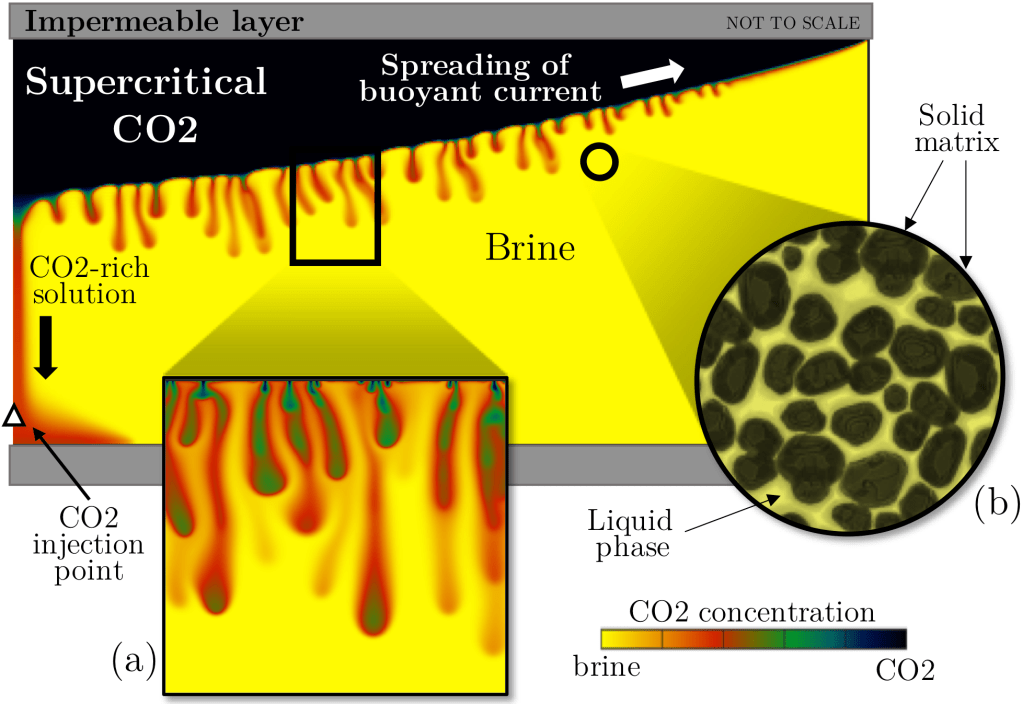
When a porous medium is filled with two fluid layers of different density, with the heavier fluid sitting on top of the lighter one, the system may become unstable. Due to the vertical density contrast, convective finger-like structures can form and accelerate fluid mixing. This configuration is representative of a variety of systems of practical interest, particularly in geophysical processes. The regular polygonally patterned ridges observed in dry salty lakes are the surface signature of the convective transport of salt in the subsurface porous soil, a fundamental process in arid regions. Formation of sea ice or solidification of multicomponent alloys may originate mushy layers, which consist of porous media filled by a multicomponent fluid subject to density gradients. It follows that the consequent convective motions control the solidification dynamics. The long-term storage of carbon dioxide in underground geological formations is also driven by convection. These examples are representative of why understanding convective mixing in porous media is crucial, for instance, to tackle grand societal challenges like energy transition, or to predict how environmental systems respond to climate change. The fluid mechanics underlying porous media convection is made complex by the multiscale and multiphase character of the flow.
Marie-Skłodowska Curie Fellowship
This fellowship (2023-2025) has been awarded by the European Commission and funds my work at the University of Twente (Physics of Fluids Group). More details available here.

Erwing Schrödinger fellowship
This fellowship (2022-2023) has been awarded by the Austrian Funding Agency (FWF) and supported my work in collaboration with Prof. Detlef Lohse at the University of Twente (Physics of Fluids Group) and Prof. Alfredo Soldati at TU Wien (Institute of Fluid Mechanics and Heat Transfer). More details available here.

 Marco De Paoli