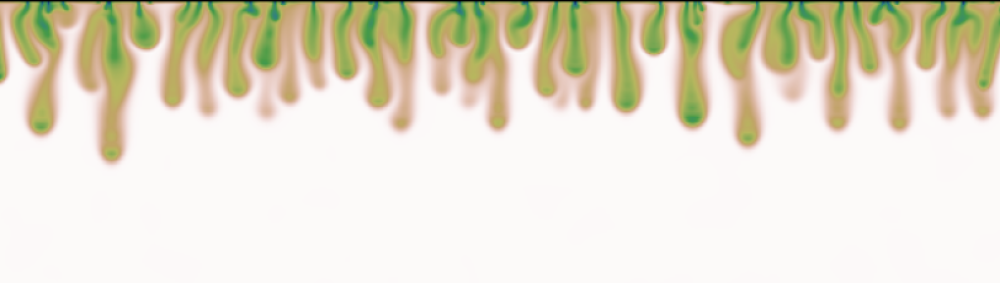
Transport and dispersion of contaminants in the subsurface are common to many geophysical and industrial applications, from the design of nuclear waste management facilities to the dispersion of chemicals and pollutants. Dispersion models to predict these scenarios exist, and are very well developed. However, when the flow is driven buoyancy forces induced by the contaminant itself, predictions are very uncertain. This is the case of salt dispersion from artificial lakes. Salt water basins are used to manage water resources in regions where the subsurface is characterised by high-salinity groundwater. Here, we provide an example.
Salt dispersion in the groundwater
One of the most important drainage systems in Australia is represented by the Murray-Darling river, a key source of water in the region. Near-surface groundwater in this basin has a high salinity. Agricultural activities have led to a rising of the water tables, with the consequence of an increased discharge of high-salt-concentration groundwater into the river basin. This process may eventually increase the river’s water salinity to unacceptable levels in periods of low flow rate in the river. To prevent this issue, high-salinity groundwater is intercepted and stored in basins at the surface level, where it may evaporate, further increasing the salt concentration. In some cases, these surface basins are designed to allow a slow and controlled leak to the underlying Murray River aquifer. This is the case for Lake Ranfurly West, which releases high-salinity water through the Channel sands aquifer into the River Murray. The hydrogeology of the system is sketched in Figure 1.

Designing and controlling such basins are key to manage the water resources efficiently and to keep the salinity of the rivers at an acceptable level. Here we apply our findings to determine the role of dispersion in the salt spreading process from the Lake Ranfurly West and the River Murray basin.
Buoyancy and dispersion: what are the effects on mixing?
We performed numerical Darcy simulations with dispersion to determine the role of dispersion and buoyancy on mixing. Exploring the effects of different physical mechanisms, namely:
- buoyancy (controlled by the Rayleigh-Darcy number, Ra);
- the anisotropy of the dispersion tensor (r), and
- the strength of dispersion compared to molecular diffusion (Δ)
we analysed the mixing process in presence of these physical mechanisms. We considered the mean scalar dissipation, which we split into 2 contributions: due to molecular diffusion (m) and due to mechanical dispersion (d), see Movie 1.
Movie 1 – Evolution of: (top left) concentration field; (right) corresponding concentration distribution at the centerline; (bottom left) molecular, dispersive and total mean scalar dissipation (solid lines), together with the analytical diffusive solution (dashed line). Results shown for Ra = 10,000, r=1 and Δ = 0.1
Conclusion
From our results, we conclude that dispersion represents the dominant mixing mechanism in salt water basins, and has to be included in the simulations to accurately design and manage these facilities. Finally, we also provide an indication of the times in which the role of dispersion is more dominant.
The manuscript is now published on Journal of Fluid Mechanics and is freely available for download here. The code AFiD-Darcy is also open sourced and available here for download.
 Marco De Paoli