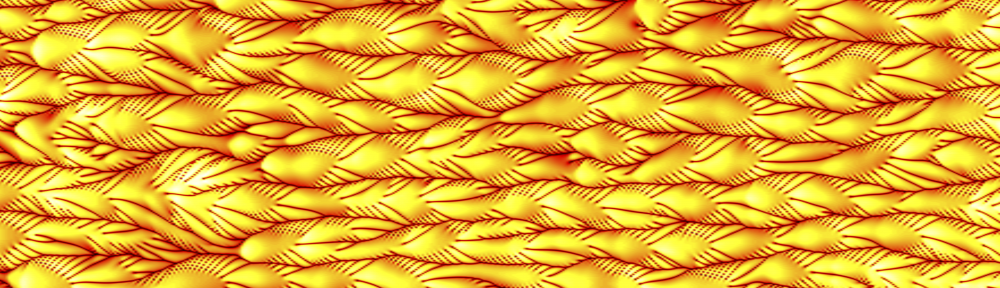
Microplastics pollution and fibers in turbulence

Microplastics pollution represents a major global problem: tiny plastic particles ending up in oceans and accumulating in living organisms may disrupt entire ecosystems. How tiny particles behave in turbulent flows is challenging to predict, especially in case of thin fibers, which represent more than half of microplastic contamination in marine life-forms.

At TU Wien we have now succeeded in characterizing the behavior of such microplastic fibers in channel flow experiments and with the help of high-speed cameras. This should now form the basis for new models that can be used to predict the spread of microplastics globally. The results have been published in Physical Review Letters.

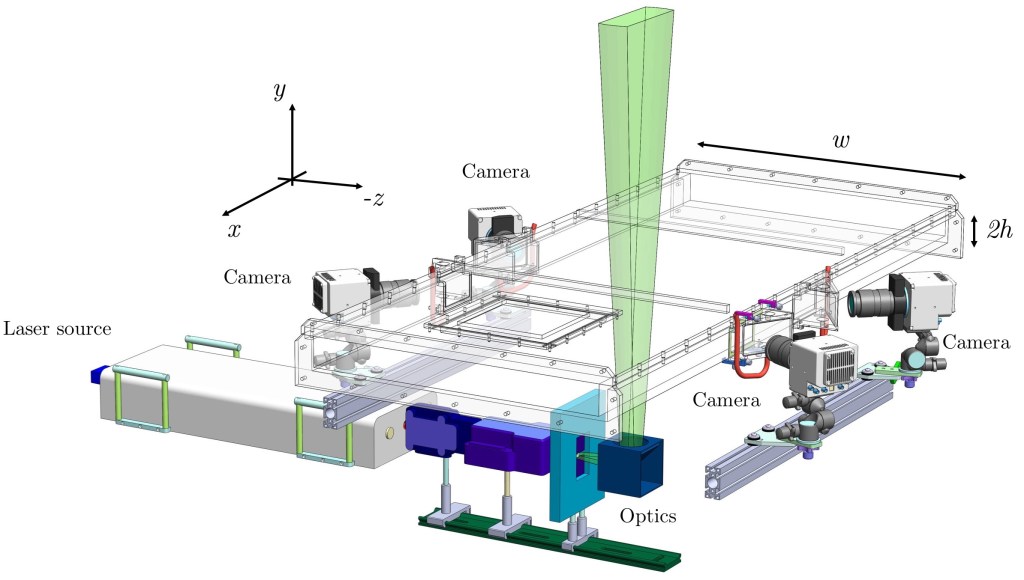
Experimental apparatus employed at TU Wien
Microplastic fibres in channel flow turbulence

Vlad Giurgiu, Giuseppe Caridi, Alfredo Soldati and I, investigated the rotational dynamics of elongated plastic fibers. Through optical experiments, we revealed unprecedented insights into the three-dimensional orientation of these particles.
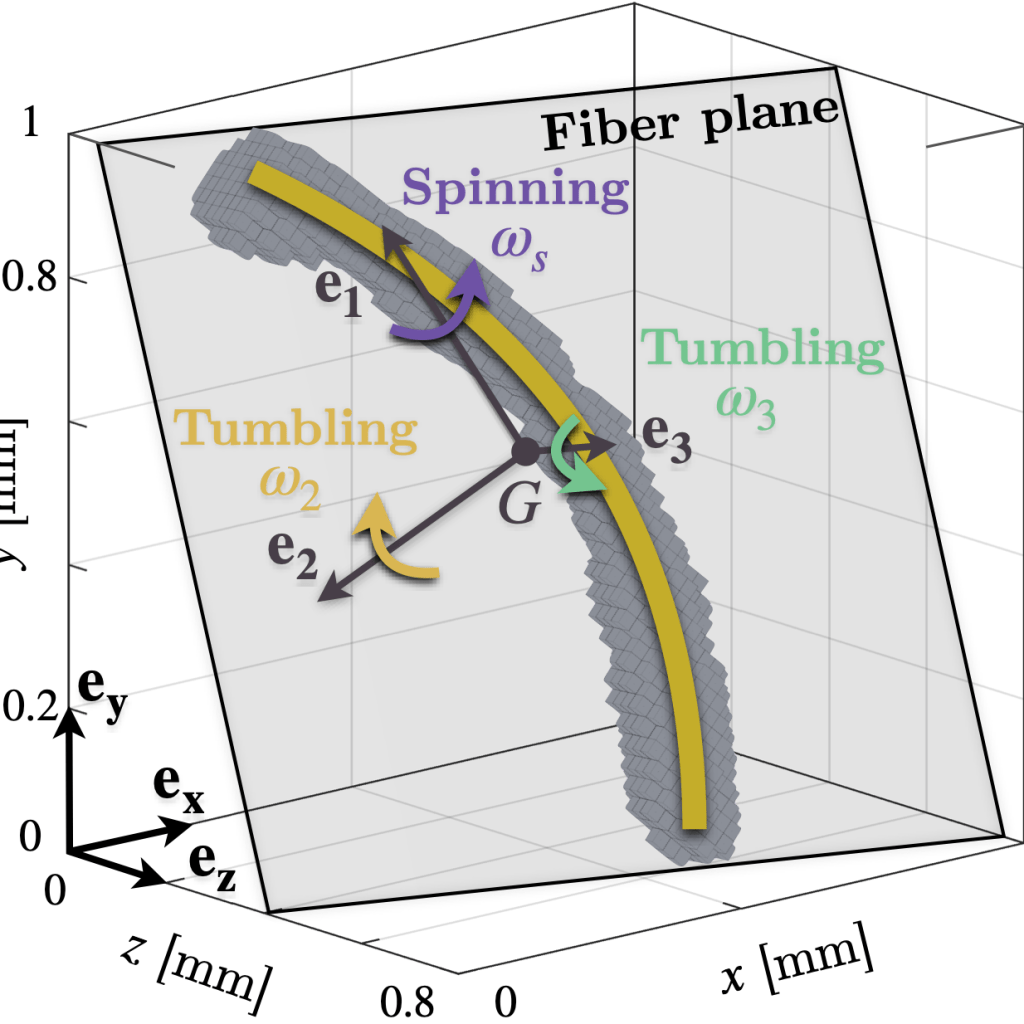
A reconstructed fiber (dark gray voxels), its fitted polynomial (yellow line), the fiber-fixed axes, and its center of mass G (black dot) are shown. Spinning (ωs) and tumbling rate components (ω2, ω3) around these axes are noted.
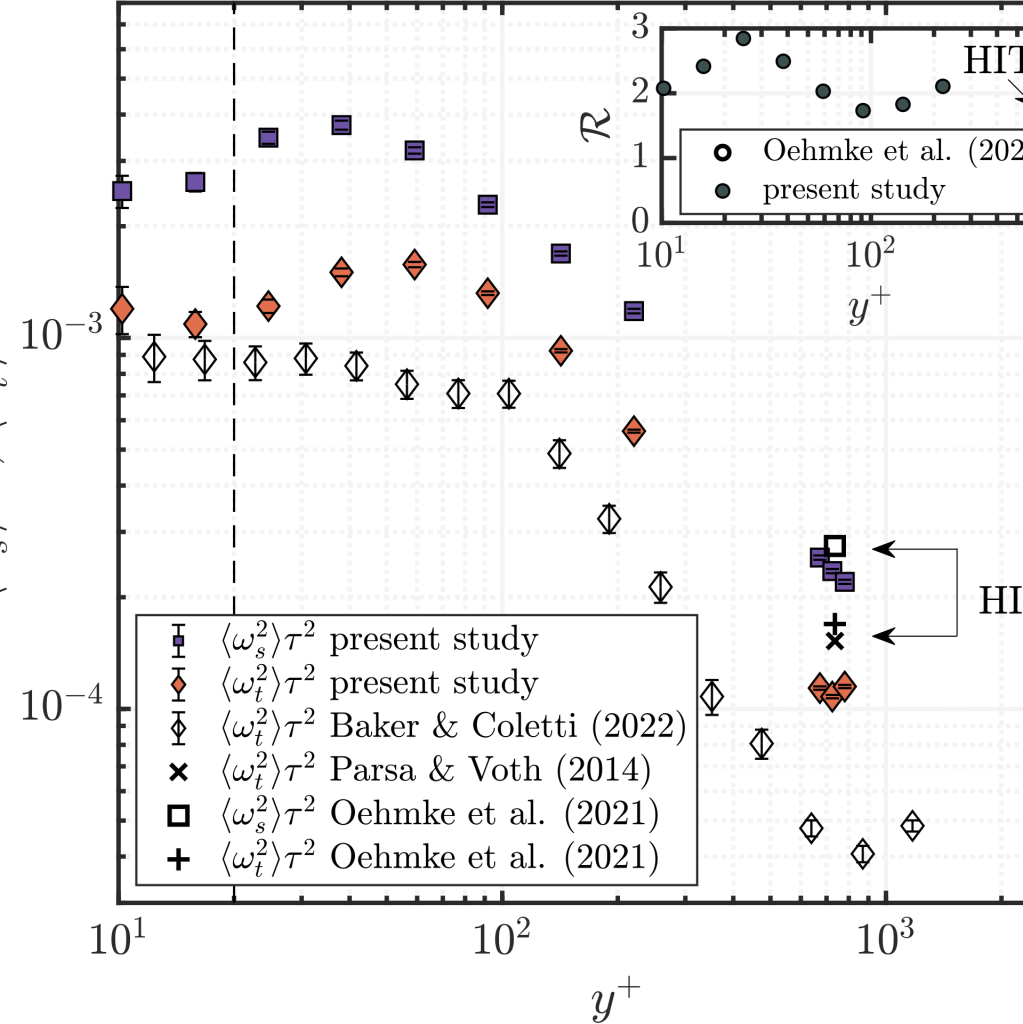
Main panel: Mean square tumbling and spinning rates normalized by the viscous timescale over the wall-normal coordinate. Inset: ratio of the mean squared spinning to mean squared tumbling rate over the wall-normal coordinate.

Our findings establish a universal behavior in the rotation rates, which is independent of the turbulent flow configuration. This achievement, together with the first spinning measurements performed in this configuration, not only opens new paths in microplastic research, but also introduces a novel approach to understand and mitigate the environmental impact of these pollutants.

We thank the Austrian Science Fund (FWF) and TU Wien for the generous funding. The manuscript and the data are freely available for download.

Link to the article and the data: Physical Review Letters and arxiv
See also the Focus story Measuring the Rotation of Polluting Plastic Particles
Processed images of fibres and tracers.

Paper published on J. Fluid Mech.

“INFLUENCE OF REYNOLDS NUMBER ON THE DYNAMICS OF RIGID, SLENDER AND NON-AXISYMMETRIC FIBRES IN CHANNEL FLOW TURBULENCE”
Experiments are performed in the TU Wien Turbulent Water Channel for three values of shear Reynolds number, namely 180, 360 and 720. The paper is open access and available here. This article follows our previous work on the reconstruction and tracking on anisotropic particles in channel flow turbulence.

In this work, we investigate experimentally the dynamics of non-axisymmetric fibres in channel flow turbulence, focusing specifically on the importance of the fibres size relative to the flow scales. To this aim, we maintain the same physical size of the fibres and we increase the shear Reynolds number. Experiments are performed in the TU Wien Turbulent Water Channel for three values of shear Reynolds number, namely 180, 360 and 720. 

Fibres are slender – length to diameter ratio of 120 -, rigid, curved and neutrally buoyant particles and their shape ranges from low curvature – almost straight fibres – to moderate curvature. In all cases, fibres size remains small compared to the channel height (1.5%). Three-dimensional and time-resolved recordings of the laser-illuminated measurement region are obtained from four high-speed cameras and used to infer fibres dynamics. With the aid of multiplicative algebraic reconstruction techniques, fibres position, orientation, velocity and rotation rates are determined. Our measurements span over half channel height, from wall to center, and allow a complete characterization of the fibres dynamics in all the regions of the flow. Specifically, we measure fibre preferential distribution and orientation. We observe that the fibres dynamics is always influenced by their curvature. Through a comparison between measurements of near-wall dynamics of fibres and near-wall dynamics of flow, we identify a causal relationship between fibre velocity and orientation, and the near-wall turbulence dynamics. Finally, we have been able to provide original measurements of the tumbling rate of the fibres, for which we report the influence of fibres curvature. We underline that our measurements confirm previous findings obtained in numerical and experimental works.