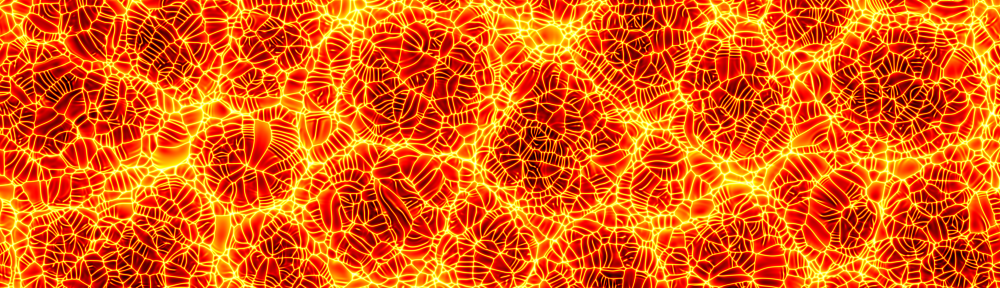

To mitigate the catastrophic effects of global warming, we will have to capture from the atmosphere billions of tons of carbon dioxide (CO2), and permanently store it underground. And there is no doubt about that. But what will it happen to carbon dioxide hundreds or thousands of meters underground? How long will it take for CO2 to mix with the resident fluid?
In our new paper, published on Geophysical Research Letters, we answer this question in the context of homogenous and isotropic rock formations. We used massively parallelized numerical simulations to systematically investigate the flow dynamics in 3D systems and provide a robust quantification of the differences occurring with respect to ideal 2D systems.
With this dataset, which we make freely available, we derive a simple, reliable and accurate physical model to describe the post‐injection dynamics of carbon dioxide. This model can be used to identify suitable sequestration sites or to design carbon dioxide injection strategies.
This project has received funding from the European Union’s Horizon Europe research and innovation programme under the Marie Sklodowska‐Curie grant agreement MEDIA No. 101062123. We acknowledge the EuroHPC Joint Undertaking (EuroHPC JU) for awarding the project GEOCOSE number EHPC‐REG‐ 2022R03‐207 and for granting access to the EuroHPC supercomputer LUMI‐C, hosted by the LUMI supercomputer consortium (Finland).
The 📕 paper and the 💻 data are freely available for download. Enjoy the convective cells in the movie below!
All the details are available here https://agupubs.onlinelibrary.wiley.com/doi/10.1029/2025GL114804
Evolution of the near-wall flow structures for Rayleigh-Darcy number 10,000. The concentration distribution over a horizontal slice taken near the upper interface. The convective time, 0 ≤ t ≤ 85, indicated in the top left corner, spans over all the regimes. Fingers appear at t ≈ 1. They subsequently merge into larger and statistically-steady cells (4 ≤ t ≤ 14). Finally, the driving reduces as a result of the domain saturation, and the near-wall cells dynamics slows progressively down.
 Marco De Paoli