Predicting dispersion of contaminants

Transport and dispersion of contaminants in the subsurface are common to many geophysical and industrial applications, from the design of nuclear waste management facilities to the dispersion of chemicals and pollutants. Dispersion models to predict these scenarios exist, and are very well developed. However, when the flow is driven buoyancy forces induced by the contaminant itself, predictions are very uncertain. This is the case of salt dispersion from artificial lakes. Salt water basins are used to manage water resources in regions where the subsurface is characterised by high-salinity groundwater. Here, we provide an example.

Salt dispersion in the groundwater

One of the most important drainage systems in Australia is represented by the Murray-Darling river, a key source of water in the region. Near-surface groundwater in this basin has a high salinity. Agricultural activities have led to a rising of the water tables, with the consequence of an increased discharge of high-salt-concentration groundwater into the river basin. This process may eventually increase the river’s water salinity to unacceptable levels in periods of low flow rate in the river. To prevent this issue, high-salinity groundwater is intercepted and stored in basins at the surface level, where it may evaporate, further increasing the salt concentration. In some cases, these surface basins are designed to allow a slow and controlled leak to the underlying Murray River aquifer. This is the case for Lake Ranfurly West, which releases high-salinity water through the Channel sands aquifer into the River Murray. The hydrogeology of the system is sketched in Figure 1.

Figure 1 – Schematic representation of the hydrogeology of the River Murray basin area (Australia).

Designing and controlling such basins are key to manage the water resources efficiently and to keep the salinity of the rivers at an acceptable level. Here we apply our findings to determine the role of dispersion in the salt spreading process from the Lake Ranfurly West and the River Murray basin.

Buoyancy and dispersion: what are the effects on mixing?

We performed numerical Darcy simulations with dispersion to determine the role of dispersion and buoyancy on mixing. Exploring the effects of different physical mechanisms, namely:

  • buoyancy (controlled by the Rayleigh-Darcy number, Ra);
  • the anisotropy of the dispersion tensor (r), and
  • the strength of dispersion compared to molecular diffusion (Δ)

we analysed the mixing process in presence of these physical mechanisms. We considered the mean scalar dissipation, which we split into 2 contributions: due to molecular diffusion (m) and due to mechanical dispersion (d), see Movie 1.


Movie 1 – Evolution of: (top left) concentration field; (right) corresponding concentration distribution at the centerline; (bottom left) molecular, dispersive and total mean scalar dissipation (solid lines), together with the analytical diffusive solution (dashed line). Results shown for Ra = 10,000, r=1 and Δ = 0.1

Conclusion

From our results, we conclude that dispersion represents the dominant mixing mechanism in salt water basins, and has to be included in the simulations to accurately design and manage these facilities. Finally, we also provide an indication of the times in which the role of dispersion is more dominant.

The manuscript is now published on Journal of Fluid Mechanics and is freely available for download here. The code AFiD-Darcy is also open sourced and available here for download.

Convective mixing of carbon dioxide : 3D vs. 2D

To mitigate the catastrophic effects of global warming, we will have to capture from the atmosphere billions of tons of carbon dioxide (CO2), and permanently store it underground. And there is no doubt about that. But what will it happen to carbon dioxide hundreds or thousands of meters underground? How long will it take for CO2 to mix with the resident fluid?

In our new paper, published on Geophysical Research Letters, we answer this question in the context of homogenous and isotropic rock formations. We used massively parallelized numerical simulations to systematically investigate the flow dynamics in 3D systems and provide a robust quantification of the differences occurring with respect to ideal 2D systems.

With this dataset, which we make freely available, we derive a simple, reliable and accurate physical model to describe the post‐injection dynamics of carbon dioxide. This model can be used to identify suitable sequestration sites or to design carbon dioxide injection strategies.

This project has received funding from the European Union’s Horizon Europe research and innovation programme under the Marie Sklodowska‐Curie grant agreement MEDIA No. 101062123. We acknowledge the EuroHPC Joint Undertaking (EuroHPC JU) for awarding the project GEOCOSE number EHPC‐REG‐ 2022R03‐207 and for granting access to the EuroHPC supercomputer LUMI‐C, hosted by the LUMI supercomputer consortium (Finland).

The 📕 paper and the 💻 data are freely available for download. Enjoy the convective cells in the movie below!

All the details are available here https://agupubs.onlinelibrary.wiley.com/doi/10.1029/2025GL114804

Evolution of the near-wall flow structures for Rayleigh-Darcy number 10,000. The concentration distribution over a horizontal slice taken near the upper interface.  The convective time, 0 ≤ t ≤ 85, indicated in the top left corner, spans over all the regimes. Fingers appear at t ≈ 1. They subsequently merge into larger and statistically-steady cells (4 ≤ t ≤ 14). Finally, the driving reduces as a result of the domain saturation, and the near-wall cells dynamics slows progressively down.

Pore-scale analysis of convective mixing in porous media

Mixing in porous media is a non-linear process. The flow is coupled to the porous matrix, but the flow structures may be much larger than the characteristic pore size. These finger-like structures form, grow and merge, and control the mixing process. In this multiphase and multiscale system, making accurate predictions is a challenging task. Mixing is controlled by the combined action of convection, diffusion and viscous dissipation. With the aid of experiments and simulations, we studied this complex system and provide simple physical models describing the flow evolution in all the stages of the mixing process.

Experiments consists of bead packs and two miscible fluids of different color. In the simulations, we combined multiple grid resolutions and immersed boundaries method to resolve high-Schmidt number flows in the pore-space. Finally, we use these results to gain a quantitative understanding of the flow evolution, and in particular of the mixing.

The paper and the data are freely accessible.

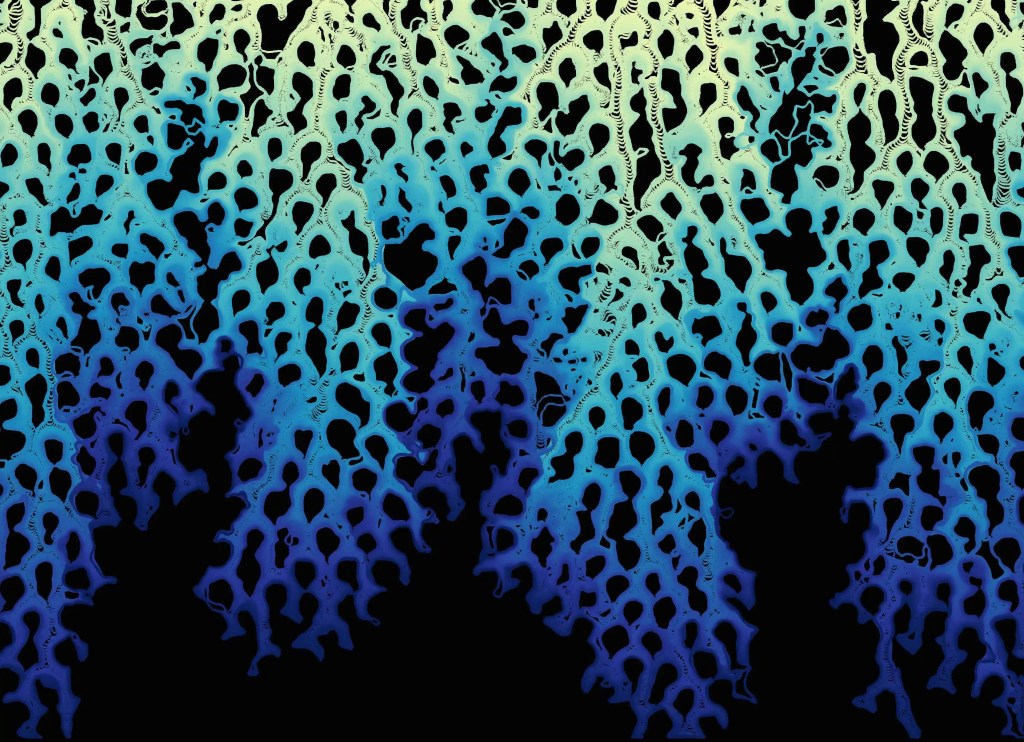
What does the image above represent? It is obtained from experimental measurements of the interface. The evolving interface between the fluids is tracked. The color changes with time, and as a results this figure contains information about the entire flow evolution. The movie below shows how the interface is tracked. Do you want to know more? Contact me!

This work was funded by the European Union’s Horizon Europe research and innovation programme under the Marie Sklodowska-Curie grant agreement MEDIA no. 101062123, the Max Planck Center for Complex Fluid Dynamics, PRACE (project 2021250115) and the Austrian Science Fund (FWF) (J-4612).

Experiments on convection in porous media

Solute transport and dispersion in underground geological formations play a key role in hydrology and geophysics, from carbon sequestration to water contamination. Understanding the underlying fluid dynamics is crucial to make reliable long-term predictions of the evolution of these systems. In this work, published on Physical Review Fluids and partially funded by the Austrian Science Fund (FWF), we investigate experimentally the role of convection on solute transport in confined porous media.

We assess experimentally the existence of a superlinear scaling for the growth of the mixing region in a confined porous medium. We employ an optical method to obtain high-resolution measurements of the density fields in Hele-Shaw flows, and we perform experiments for large values of the Rayleigh-Darcy number. We can confirm that the growth of the mixing length during the convection-dominated phase follows the scaling predicted by previous two-dimensional simulations. 

Thank you Diego Perissutti (visiting Master student at TU Wien at the time of the experiments, now PhD candidate at the University of Udine), Cristian Marchioli (University of Udine) and Alfredo Soldati (TU Wien and University of Udine) for the collaboration. This work has been partially performed at the University of Twente, Physics of Fluids Group.

In the movie, you can see the evolution of the finger number for one of the experiments considered.  Article, visualizations, and data about this work are available here:

[1] De Paoli et al., arXiv:2206.13363 (2022), https://arxiv.org/abs/2206.13363
[2] De Paoli et al., Phys. Rev. Fluids 7, 093503 (2022), https://journals.aps.org/prfluids/abstract/10.1103/PhysRevFluids.7.093503
[3] De Paoli et al., Data and figures in MatLab format, https://doi.org/10.6084/m9.figshare.19761766.v3
[4] Movie 1 https://youtu.be/njuebV7mLxw
[5] Movie 2 https://youtu.be/lC8Xbfal4J0

What is the flow topology of a convective porous media flow?

What is the minimum domain size we need to simulate to capture the large-scale flow structures?

We have addressed these questions in our recent work published on Journal of Fluid Mechanics. With the aid of massively parallelized numerical simulations, we show that the near-wall, large-scale temperature patterns (supercells) represent the footprint of the flow structure in the core of the domain (megaplumes). We have also analyzed the effect of the domain size (aspect ratio, AR), on the resulting flow topology.