How to study the behaviour of microplastics?

Microplastics are plastic fragments smaller than 5 mm originated from human activities, and have been found everywhere, also in the remotest places of the Earth. Measuring their position and velocity in turbulent flows, such as ocean, rivers and lakes, is crucial to better understand their behaviour and make physical models that describe their paths. To this aim, we designed a new facility, the TU Wien turbulent Water Channel, which we recently presented in paper published on Review in Scientific Instrument. This project is funded by FWF (Austrian Science Fund).
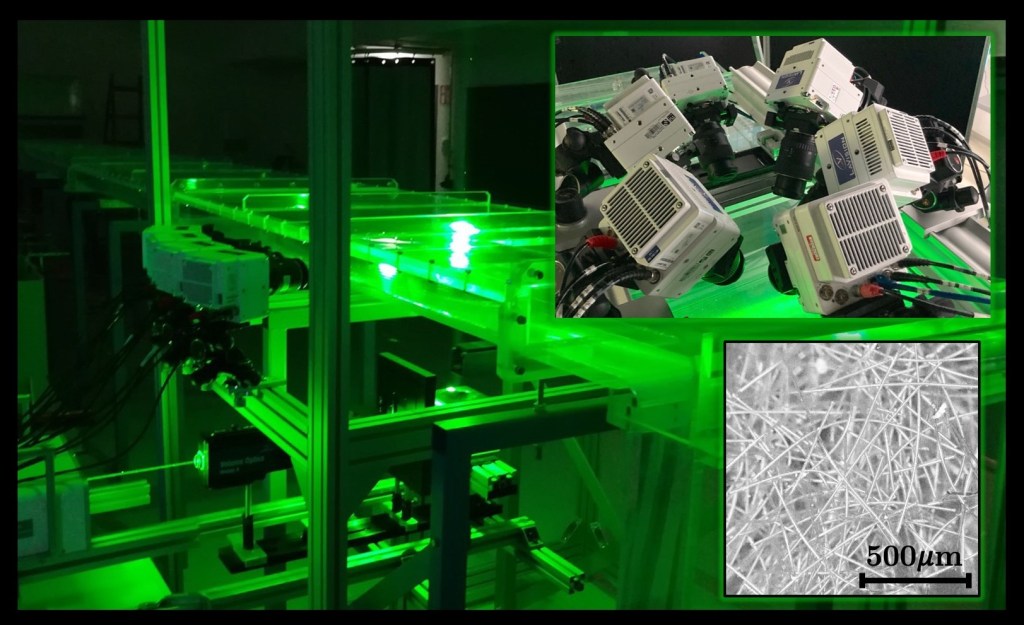
The TU Wien Turbulent Water Channel (main figure). Cameras may be arranged in different configurations to investigate the behaviour of microplastics (bottom right figure).

The TU Wien Turbulent Water Channel is a 3000 litres volume and 10 meters long flow loop designed for 3D and time-resolved measurements of anisotropic particles dynamics. We developed a novel approach to track microplastics, since they are usually anisotropic and techniques developed for spherical particles are not suitable to track such objects. In addition, in this work, we provide guidelines to design turbulent water ducts, and we also compare against existing facilities.

The data and the paper (Open Access) are freely available for download.

Would you like to perform experiments in the TU Wien Turbulent Water Channel? Contact us!

This work has been selected for the Kudos Research Showcase.
Paper published on J. Fluid Mech.

“INFLUENCE OF REYNOLDS NUMBER ON THE DYNAMICS OF RIGID, SLENDER AND NON-AXISYMMETRIC FIBRES IN CHANNEL FLOW TURBULENCE”
Experiments are performed in the TU Wien Turbulent Water Channel for three values of shear Reynolds number, namely 180, 360 and 720. The paper is open access and available here. This article follows our previous work on the reconstruction and tracking on anisotropic particles in channel flow turbulence.

In this work, we investigate experimentally the dynamics of non-axisymmetric fibres in channel flow turbulence, focusing specifically on the importance of the fibres size relative to the flow scales. To this aim, we maintain the same physical size of the fibres and we increase the shear Reynolds number. Experiments are performed in the TU Wien Turbulent Water Channel for three values of shear Reynolds number, namely 180, 360 and 720. 

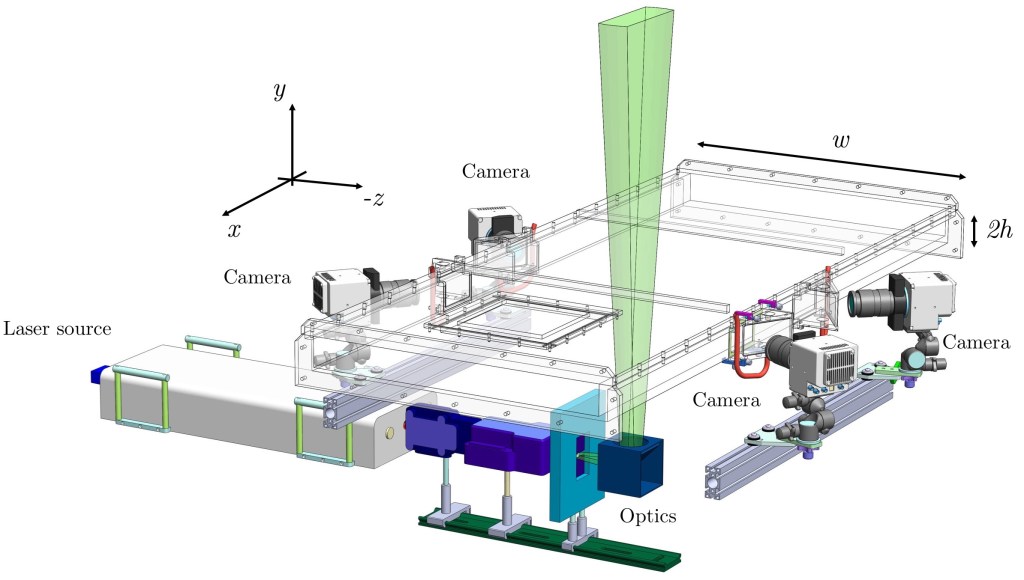
Fibres are slender – length to diameter ratio of 120 -, rigid, curved and neutrally buoyant particles and their shape ranges from low curvature – almost straight fibres – to moderate curvature. In all cases, fibres size remains small compared to the channel height (1.5%). Three-dimensional and time-resolved recordings of the laser-illuminated measurement region are obtained from four high-speed cameras and used to infer fibres dynamics. With the aid of multiplicative algebraic reconstruction techniques, fibres position, orientation, velocity and rotation rates are determined. Our measurements span over half channel height, from wall to center, and allow a complete characterization of the fibres dynamics in all the regions of the flow. Specifically, we measure fibre preferential distribution and orientation. We observe that the fibres dynamics is always influenced by their curvature. Through a comparison between measurements of near-wall dynamics of fibres and near-wall dynamics of flow, we identify a causal relationship between fibre velocity and orientation, and the near-wall turbulence dynamics. Finally, we have been able to provide original measurements of the tumbling rate of the fibres, for which we report the influence of fibres curvature. We underline that our measurements confirm previous findings obtained in numerical and experimental works.