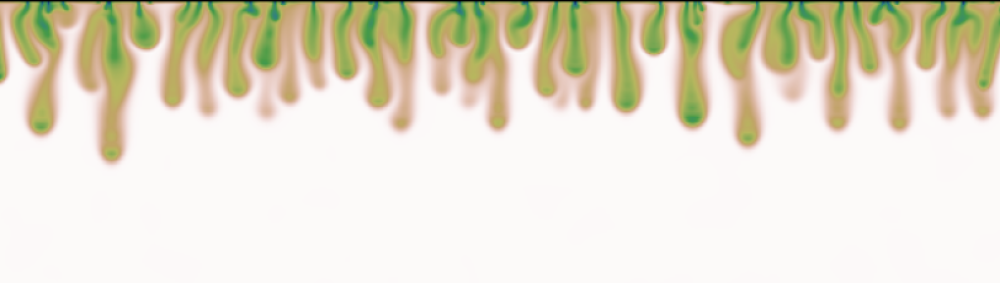
ERC Starting grant awarded

Featured

Exciting news today! I have been awarded an ERC StG. This 1.5 Million Euro grant will allow me to build a team to investigate flows in porous media with morphology modifications. What do rocks, ice and snow have in common? Find it out here!

MORPHOS – Flow-induced morphology modifications in porous multiscale systems

Porous media with morphology modifications are everywhere around us. For example, think of a snowpack subject to snow melting and water refreezing. Snow represents one of the largest freshwater resources available on Earth, and predicting its dynamics is crucial to have reliable climate models. But… snow is an extremely complex system, consisting of a solid icy matrix filled with air. When the ice crystals at the top of the snowpack melt due to the solar radiation, the resulting meltwater penetrates downwards, eventually refreezing. Water, ice and air interact in a complex manner, exchanging heat and influencing each other dynamics: as a result, predicting the evolution of snowpacks is challenging.

Another example of flow-induced morphology evolution is the dissolution of rocks in underground formations. During the process of geological carbon dioxide sequestration or in presence of Karstic formations, the porous rocks “dissolve” or “grow” due to the local increase of the concentration of minerals, e.g., calcite. This effect produces a variation in the medium morphology, namely new paths may open or existing pores close, and thus influences the flow: also in this case, determining the effect of the flow on the medium morphology, and viceversa, is arduous: dissolution or mineralization occur over hundreds or thousands of years, and experiments and modelling in analogue systems are essential.

A further category of processes involving flow-induced morphology variations is represented by the formation of sea ice or the solidification of multicomponent alloys. For instance, when sea ice forms, water solidifies generating an icy porous matrix, while salt is rejected, producing a local increase of the salt concentration (a video capturing possible consequences of this fascinating phenomenon is shown below). This will make sea water denser and generate a flow that interacts with the newly formed porous ice, influencing the subsequent system evolution.

These are just few of the natural and industrial processes involving flow-induced morphology modifications. In addition to the tangled fluid-medium interactions mentioned above, the dynamics of these systems is made more complex by their multiscale nature: the transport processes occurring at the small scales (pore-scale) influence also the large-scale dynamics, and investigating all these phenomena simultaneously is an ambitious task. In this project, with simulations, experiments and physical models, we will shed new light on the elusive dynamics of these complex systems.

Stay tuned, updates will follow! [see this page]

See also the press release by ERC and TU Wien, and the articles with details on the project in English and German.

Featured

DateEventPlaceresource
8/12/2025Keynote presentation at International Workshop on Porous mediaBergenlink
25/11/25Interview (TV and radio) on CCS with ORFWien, Austrialink, link
23/11/25Presentation at APS-DFDHouston, US
21/11/25Invite Colloquium at New Jersey Institute of TechnologyNewark, US
4/11/25Press release published by TU Wienlink
1/10/25Paper published in J. Fluid Mech.pdf
16/9/25Interview for weltderphysiklink
28/8/25Presentation at EFDC2Dublinpdf
20/5/25Presentation at Interpore 2025Albuquerquepdf
2/5/25Paper published in Exp. Fluidslink
30/4/25Phantom case study publishedlink, pdf
8/4/25Press releases by TU Wien. See also articles by die Presse, APA, ORF, der Standard, Aljazeera, Salzburger Nachrichten, …link
8/4/25Invited seminar at Comput. Phys. Comm. Seminar seriesrecording
1/4/25Paper published on Geophys. Res. Lett.link
13/3/25Paper and code published on Comput. Phys. Comm.link, code
14/2/25Invited seminar at Sapienza UniversityRome (Italy)pdf
20/11/24Poster at APS-DFD Annual MeetingSalt Lake City (US)pdf
31/10/24Presentation at JMBC Contact Group “Turbulence”Eindhoven (NL)pdf
18/9/24Interview to Innovation OriginsEindhoven (NL)link
5/9/24🚨 ERC Starting Grant awarded 🚨link
20/8/24Paper published in J. Fluid Mech.pdf
17/7/24Poster at Gordon Research ConferenceNewry (US)pdf
10/7/24Invited talk at CaltechPasadena (US)ppt
16/5/24Paper published in J. Fluid Mech.link, pdf
9/5/24Invited talk the University of PisaPisa (Italy)ppt
7/5/24Presentation at Euromech Colloquium 639Lerici (Italy)
29/4/24Presentation at Max Planck Center MeetingBad Boekelo (NL)ppt
14/3/24Invited talk at the Lab. Fluid Mech. LilleLille (France)recording, ppt
12/3/24Invited talk at the Lab. of Complex FluidsAnglet (France)ppt
19/12/23Paper Highlighted by Eur. Phys. J. Elink
16/12/23Paper published in Eur. Phys. J. Epdf
20/11/23Presentation at APS-DFD Washingtonppt
16/11/23Presentation at the Fluid Dynamics Meeting Philadelphiappt
14/11/23Invited talk at the PoreLab Lecture SeriesOslo (online)recording, ppt
27/10/23Presentation at JMBC Contact Group “Turbulence”Delftppt
13/9/23Presentation at 10th GACM colloquiumViennappt
13/9/23Organisation of Symposium at 10th GACM ColloquiumVienna
10/9/23Co-chair of 10th GACM colloquiumVienna
9/9/23Paper selected by AIPP for Kudos Showcase
7/9/23Paper published in Rev. Sci. Instrum. paper
29/8/23Participation to IJMF 50Vienna
31/5/23Participation to Burgers Symposium 2023Lunteren
22/5/23Presentation at InterPore 2023Edinburghppt
1/1/23Appointed Associate Editor of EPJ – E

Predicting dispersion of contaminants

Transport and dispersion of contaminants in the subsurface are common to many geophysical and industrial applications, from the design of nuclear waste management facilities to the dispersion of chemicals and pollutants. Dispersion models to predict these scenarios exist, and are very well developed. However, when the flow is driven buoyancy forces induced by the contaminant itself, predictions are very uncertain. This is the case of salt dispersion from artificial lakes. Salt water basins are used to manage water resources in regions where the subsurface is characterised by high-salinity groundwater. Here, we provide an example.

Salt dispersion in the groundwater

One of the most important drainage systems in Australia is represented by the Murray-Darling river, a key source of water in the region. Near-surface groundwater in this basin has a high salinity. Agricultural activities have led to a rising of the water tables, with the consequence of an increased discharge of high-salt-concentration groundwater into the river basin. This process may eventually increase the river’s water salinity to unacceptable levels in periods of low flow rate in the river. To prevent this issue, high-salinity groundwater is intercepted and stored in basins at the surface level, where it may evaporate, further increasing the salt concentration. In some cases, these surface basins are designed to allow a slow and controlled leak to the underlying Murray River aquifer. This is the case for Lake Ranfurly West, which releases high-salinity water through the Channel sands aquifer into the River Murray. The hydrogeology of the system is sketched in Figure 1.

Figure 1 – Schematic representation of the hydrogeology of the River Murray basin area (Australia).

Designing and controlling such basins are key to manage the water resources efficiently and to keep the salinity of the rivers at an acceptable level. Here we apply our findings to determine the role of dispersion in the salt spreading process from the Lake Ranfurly West and the River Murray basin.

Buoyancy and dispersion: what are the effects on mixing?

We performed numerical Darcy simulations with dispersion to determine the role of dispersion and buoyancy on mixing. Exploring the effects of different physical mechanisms, namely:

  • buoyancy (controlled by the Rayleigh-Darcy number, Ra);
  • the anisotropy of the dispersion tensor (r), and
  • the strength of dispersion compared to molecular diffusion (Δ)

we analysed the mixing process in presence of these physical mechanisms. We considered the mean scalar dissipation, which we split into 2 contributions: due to molecular diffusion (m) and due to mechanical dispersion (d), see Movie 1.


Movie 1 – Evolution of: (top left) concentration field; (right) corresponding concentration distribution at the centerline; (bottom left) molecular, dispersive and total mean scalar dissipation (solid lines), together with the analytical diffusive solution (dashed line). Results shown for Ra = 10,000, r=1 and Δ = 0.1

Conclusion

From our results, we conclude that dispersion represents the dominant mixing mechanism in salt water basins, and has to be included in the simulations to accurately design and manage these facilities. Finally, we also provide an indication of the times in which the role of dispersion is more dominant.

The manuscript is now published on Journal of Fluid Mechanics and is freely available for download here. The code AFiD-Darcy is also open sourced and available here for download.

Convective mixing of carbon dioxide : 3D vs. 2D

To mitigate the catastrophic effects of global warming, we will have to capture from the atmosphere billions of tons of carbon dioxide (CO2), and permanently store it underground. And there is no doubt about that. But what will it happen to carbon dioxide hundreds or thousands of meters underground? How long will it take for CO2 to mix with the resident fluid?

In our new paper, published on Geophysical Research Letters, we answer this question in the context of homogenous and isotropic rock formations. We used massively parallelized numerical simulations to systematically investigate the flow dynamics in 3D systems and provide a robust quantification of the differences occurring with respect to ideal 2D systems.

With this dataset, which we make freely available, we derive a simple, reliable and accurate physical model to describe the post‐injection dynamics of carbon dioxide. This model can be used to identify suitable sequestration sites or to design carbon dioxide injection strategies.

This project has received funding from the European Union’s Horizon Europe research and innovation programme under the Marie Sklodowska‐Curie grant agreement MEDIA No. 101062123. We acknowledge the EuroHPC Joint Undertaking (EuroHPC JU) for awarding the project GEOCOSE number EHPC‐REG‐ 2022R03‐207 and for granting access to the EuroHPC supercomputer LUMI‐C, hosted by the LUMI supercomputer consortium (Finland).

The 📕 paper and the 💻 data are freely available for download. Enjoy the convective cells in the movie below!

All the details are available here https://agupubs.onlinelibrary.wiley.com/doi/10.1029/2025GL114804

Evolution of the near-wall flow structures for Rayleigh-Darcy number 10,000. The concentration distribution over a horizontal slice taken near the upper interface.  The convective time, 0 ≤ t ≤ 85, indicated in the top left corner, spans over all the regimes. Fingers appear at t ≈ 1. They subsequently merge into larger and statistically-steady cells (4 ≤ t ≤ 14). Finally, the driving reduces as a result of the domain saturation, and the near-wall cells dynamics slows progressively down.

Microplastics pollution and fibers in turbulence

Microplastics pollution represents a major global problem: tiny plastic particles ending up in oceans and accumulating in living organisms may disrupt entire ecosystems. How tiny particles behave in turbulent flows is challenging to predict, especially in case of thin fibers, which represent more than half of microplastic contamination in marine life-forms.

At TU Wien we have now succeeded in characterizing the behavior of such microplastic fibers in channel flow experiments and with the help of high-speed cameras. This should now form the basis for new models that can be used to predict the spread of microplastics globally. The results have been published in Physical Review Letters.

Experimental apparatus employed at TU Wien
Microplastic fibres in channel flow turbulence

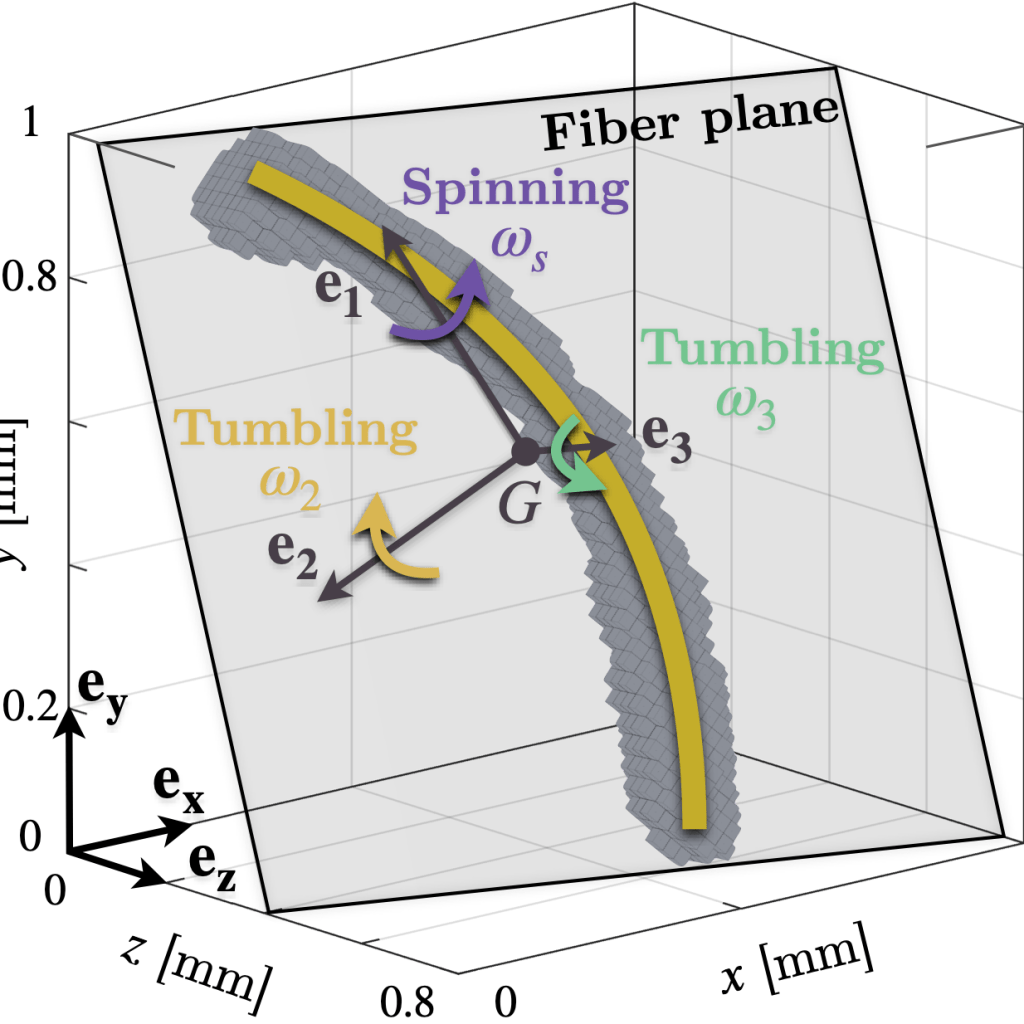
Vlad Giurgiu, Giuseppe Caridi, Alfredo Soldati and I, investigated the rotational dynamics of elongated plastic fibers. Through optical experiments, we revealed unprecedented insights into the three-dimensional orientation of these particles.

A reconstructed fiber (dark gray voxels), its fitted polynomial (yellow line), the fiber-fixed axes, and its center of mass G (black dot) are shown. Spinning (ωs) and tumbling rate components (ω2, ω3) around these axes are noted.
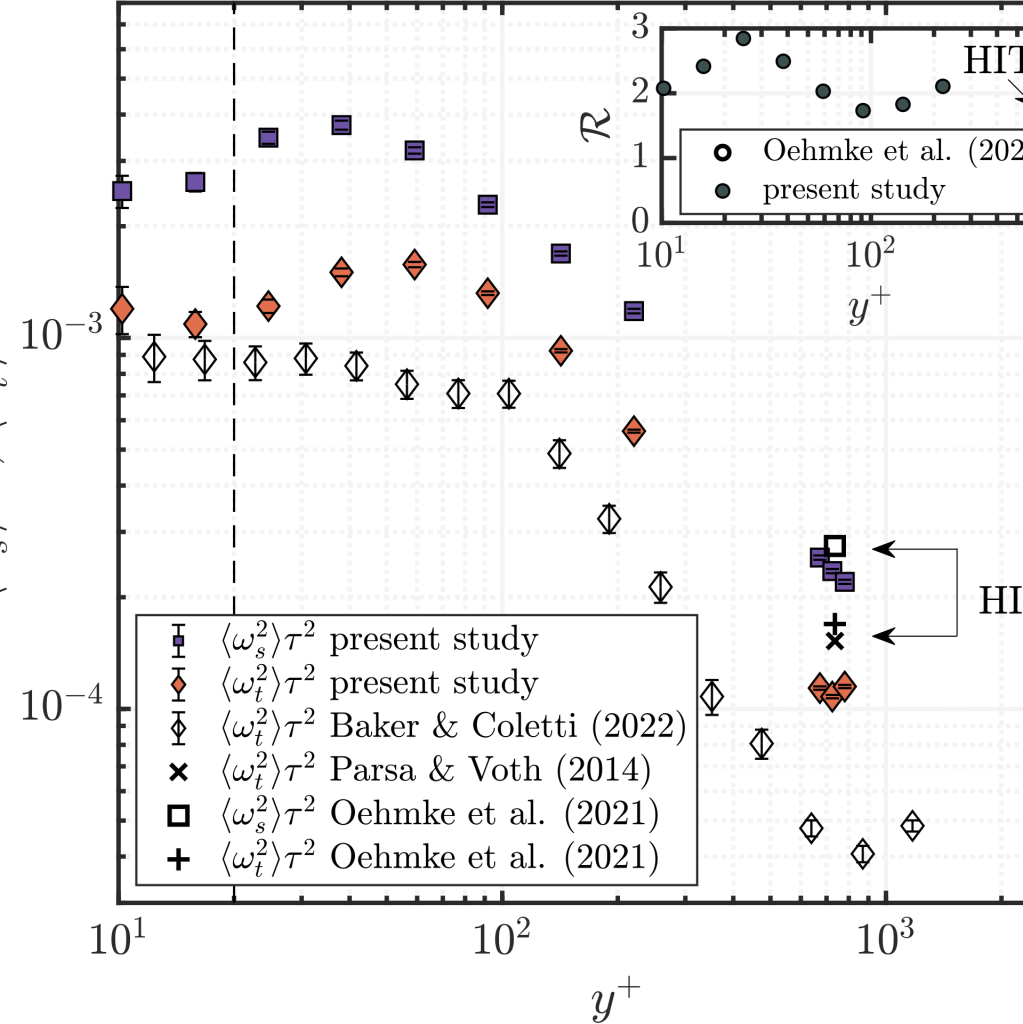
Main panel: Mean square tumbling and spinning rates normalized by the viscous timescale over the wall-normal coordinate. Inset: ratio of the mean squared spinning to mean squared tumbling rate over the wall-normal coordinate.

Our findings establish a universal behavior in the rotation rates, which is independent of the turbulent flow configuration. This achievement, together with the first spinning measurements performed in this configuration, not only opens new paths in microplastic research, but also introduces a novel approach to understand and mitigate the environmental impact of these pollutants.

We thank the Austrian Science Fund (FWF) and TU Wien for the generous funding. The manuscript and the data are freely available for download.

Link to the article and the data: Physical Review Letters and arxiv
See also the Focus story Measuring the Rotation of Polluting Plastic Particles

Processed images of fibres and tracers.

Pore-scale analysis of convective mixing in porous media

Mixing in porous media is a non-linear process. The flow is coupled to the porous matrix, but the flow structures may be much larger than the characteristic pore size. These finger-like structures form, grow and merge, and control the mixing process. In this multiphase and multiscale system, making accurate predictions is a challenging task. Mixing is controlled by the combined action of convection, diffusion and viscous dissipation. With the aid of experiments and simulations, we studied this complex system and provide simple physical models describing the flow evolution in all the stages of the mixing process.

Experiments consists of bead packs and two miscible fluids of different color. In the simulations, we combined multiple grid resolutions and immersed boundaries method to resolve high-Schmidt number flows in the pore-space. Finally, we use these results to gain a quantitative understanding of the flow evolution, and in particular of the mixing.

The paper and the data are freely accessible.

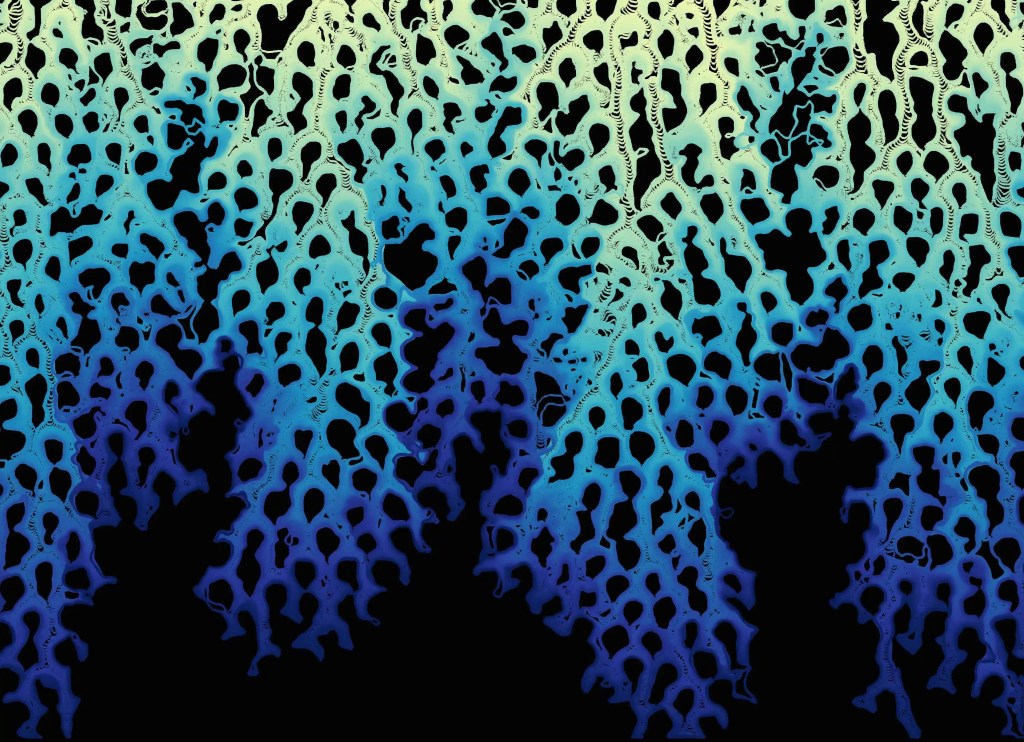
What does the image above represent? It is obtained from experimental measurements of the interface. The evolving interface between the fluids is tracked. The color changes with time, and as a results this figure contains information about the entire flow evolution. The movie below shows how the interface is tracked. Do you want to know more? Contact me!

This work was funded by the European Union’s Horizon Europe research and innovation programme under the Marie Sklodowska-Curie grant agreement MEDIA no. 101062123, the Max Planck Center for Complex Fluid Dynamics, PRACE (project 2021250115) and the Austrian Science Fund (FWF) (J-4612).

Review paper published in The European Physical Journal E

Can we predict the formation of sea ice? And the dissolution of CO2 in geological reservoirs? These phenomena are controlled by convective motions in a porous medium. In this review article fresh off the presses, published in The European Physical Journal E, I present recent advances on convection in porous media, a paramount topic for climate change and energy transition. The paper (Open Access) is freely available for download at here.

When a porous medium is filled with two fluid layers of different density, with the heavier fluid sitting on top of the lighter one, the system may become unstable. Due to the vertical density contrast, convective finger-like structures can form and accelerate fluid mixing. This configuration is representative of a variety of systems of practical interest, particularly in geophysical processes.

The regular polygonally patterned ridges observed in dry salty lakes are the surface signature of the convective transport of salt in the subsurface porous soil, a fundamental process in arid regions. Formation of sea ice or solidification of multicomponent alloys may originate mushy layers, which consist of porous media filled by a multicomponent fluid subject to density gradients. It follows that the consequent convective motions control the solidification dynamics. The long-term storage of carbon dioxide in underground geological formations is also driven by convection. These examples are representative of why understanding convective mixing in porous media is crucial, for instance, to tackle grand societal challenges like energy transition, or to predict how environmental systems respond to climate change.

The fluid mechanics underlying porous media convection is made complex by the multiscale and multiphase character of the flow. As a result, a combination of different complementary approaches has been deployed to elucidate the intricate physics of convection in porous media. This work reviews recent numerical, experimental, and theoretical findings, discusses their limits of applicability, and highlights possible future research directions.

How to study the behaviour of microplastics?

Microplastics are plastic fragments smaller than 5 mm originated from human activities, and have been found everywhere, also in the remotest places of the Earth. Measuring their position and velocity in turbulent flows, such as ocean, rivers and lakes, is crucial to better understand their behaviour and make physical models that describe their paths. To this aim, we designed a new facility, the TU Wien turbulent Water Channel, which we recently presented in paper published on Review in Scientific Instrument. This project is funded by FWF (Austrian Science Fund).

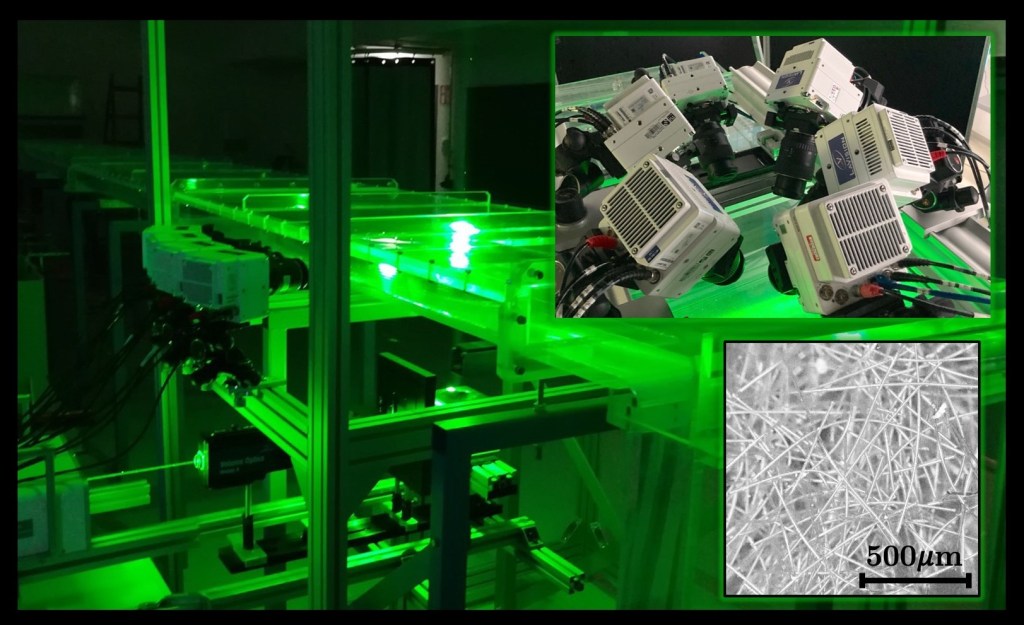
The TU Wien Turbulent Water Channel (main figure). Cameras may be arranged in different configurations to investigate the behaviour of microplastics (bottom right figure).

The TU Wien Turbulent Water Channel is a 3000 litres volume and 10 meters long flow loop designed for 3D and time-resolved measurements of anisotropic particles dynamics. We developed a novel approach to track microplastics, since they are usually anisotropic and techniques developed for spherical particles are not suitable to track such objects. In addition, in this work, we provide guidelines to design turbulent water ducts, and we also compare against existing facilities.

The data and the paper (Open Access) are freely available for download.

Would you like to perform experiments in the TU Wien Turbulent Water Channel? Contact us!

This work has been selected for the Kudos Research Showcase.

Experiments on convection in porous media

Solute transport and dispersion in underground geological formations play a key role in hydrology and geophysics, from carbon sequestration to water contamination. Understanding the underlying fluid dynamics is crucial to make reliable long-term predictions of the evolution of these systems. In this work, published on Physical Review Fluids and partially funded by the Austrian Science Fund (FWF), we investigate experimentally the role of convection on solute transport in confined porous media.

We assess experimentally the existence of a superlinear scaling for the growth of the mixing region in a confined porous medium. We employ an optical method to obtain high-resolution measurements of the density fields in Hele-Shaw flows, and we perform experiments for large values of the Rayleigh-Darcy number. We can confirm that the growth of the mixing length during the convection-dominated phase follows the scaling predicted by previous two-dimensional simulations. 

Thank you Diego Perissutti (visiting Master student at TU Wien at the time of the experiments, now PhD candidate at the University of Udine), Cristian Marchioli (University of Udine) and Alfredo Soldati (TU Wien and University of Udine) for the collaboration. This work has been partially performed at the University of Twente, Physics of Fluids Group.

In the movie, you can see the evolution of the finger number for one of the experiments considered.  Article, visualizations, and data about this work are available here:

[1] De Paoli et al., arXiv:2206.13363 (2022), https://arxiv.org/abs/2206.13363
[2] De Paoli et al., Phys. Rev. Fluids 7, 093503 (2022), https://journals.aps.org/prfluids/abstract/10.1103/PhysRevFluids.7.093503
[3] De Paoli et al., Data and figures in MatLab format, https://doi.org/10.6084/m9.figshare.19761766.v3
[4] Movie 1 https://youtu.be/njuebV7mLxw
[5] Movie 2 https://youtu.be/lC8Xbfal4J0

What is the flow topology of a convective porous media flow?

What is the minimum domain size we need to simulate to capture the large-scale flow structures?

We have addressed these questions in our recent work published on Journal of Fluid Mechanics. With the aid of massively parallelized numerical simulations, we show that the near-wall, large-scale temperature patterns (supercells) represent the footprint of the flow structure in the core of the domain (megaplumes). We have also analyzed the effect of the domain size (aspect ratio, AR), on the resulting flow topology.